27 October 2014

What I have learn at the college

As of October 2014, I have left the North Warwickshire and Hinckley College. Just before that, I was approached by a colleague from another college to share my ideas on the college library service development. This is my reply which I have edited slightly. Though it is not a well-polished text, I believe it may be of use to a reflection on what a good college library should or may look like.

The library has to be an integral part of the college. If the college management don't see the library as the key service for developing digital literacy or promoting use of ILT/ICT in teaching and learning, there won't be much librarians can do about it. If e-learning isn't explicitly planted into the LRS structure, the best way of moving forward would be developing partnerships; for example, introducing blogging into learning practice, bidding for funding for purchasing iPads etc. Partnerships allow involving others into the library's concerns, making them co-responsible, as well as benefiting from successes.

Over the years, I have increasingly started valuing working with tutors. Certainly, there is a scope for direct involvement with students, but my experience suggests that unless such involvement relates to the course content directly, students are reluctant to make use of our best offers. To make our work relevant, we have to work with tutors.

09 October 2014

One size doesn’t fit all: budget implication for developing the HE in FE library provision

This article was written for the CoLRiC Newsletter in August 2014.

It is likely that most of FE colleges will see their HE provision growing rapidly in the near future – the Government wants to bring even more competition to the educational market and encourage innovative developments across the sectors. This offers both opportunities and challenges to learning resources services (LRS) in FE colleges. Here, I would like to suggest few budget-related ideas on how the HE-related developments could be successfully accommodated in FE LRS.

28 May 2014

Using URL Shorteners for Measuring Impact

After attending few CoLRiC events recently, one phrase stays with me: measuring impact. – Hard and comprehensive data is persuasive and helpful for critical reflection.

One tool I have been using for gathering data is URL (web link) shorteners. In my library, we initially adopted bit.ly to tame the URLs to various help pages on the library blog, e.g. how to access ebooks from home. Shorter URLs look less frightening in emails and catalogue records too. Later, we have moved to goo.gl simply because we’d been using other Google services.

Both bit.ly and goo.gl, as well as other similar services, can provide us with helpful statistics on how many times the document behind the shortened URL has been accessed. The trick is to remember to login into the service account before shortening that URL, of course.

Here is a real-life example. A month ago I scanned a book excerpt for a Biology tutor. The file then was uploaded into the library’s Dropbox shared folder and the URL was shortened with goo.gl. The tutor placed the URL onto the Moodle page for his course (experientially, we have learnt that tutors preferred getting web links to files for uploading – file upload with Moodle is notoriously cumbersome). After two weeks, the scanned document has been accessed 50 times. This is a good piece of evidence that the scanning service the library offers is well used, relevant and worth of time spent. If no clicks were received, it would be a sign that the tutors have not made the link available to students – something for me to follow up then.

In the same way, I can see with goo.gl how often our helpsheets are downloaded or what the impact of various promotion campaigns is. Using URL shorteners has prompted new conversations and changes in practice in our library.

This post was originally published in the CoLRiC Newsletter, no. 61.

17 March 2014

User survey – how we do it

It is the season for user surveys in college libraries and learning resources centres. It must be exciting – learning something new about our students and ourselves.

In my library, we are already done! – I spent the recent half term week analysing the survey results and now contacting tutors and students to clarify their concerns, invite for collaboration and answer their complaints; also, preparing to update the team and making a task list to address all the above. – Everything is treated as an opportunity for developing the service. You can see the results on our blog; they aren’t great (judging by the CoLRiC PII questions the survey includes) – we had better years.

Experientially, we have worked out the way of conducting an annual survey that works best for us; we have learnt also to ask only the questions we really can utilise – nothing out of sheer curiosity.

The survey is done online and on paper – to capture the users of different preferences. This year we moved to Google Docs – it gives enough flexibility and plenty of independence. The online form can be seen at http://goo.gl/DiJBEA. The output can be saved as an Excel spreadsheet; some basic data filtering and chart creation skills (any Microsoft Office Excel book has it) will help to build attractive visual representations of the users’ replies.

We are using Heritage LMS; it allows sending email notifications to the selected groups of users; in this case, an invitation to fill the online survey was sent to anyone who made at least one loan this year – we call them active users. There is no much point in asking about use of the library those who have not used it at all; however posting the link to the college’s Moodle home page allows us to capture non-users’ views of what will make the library more attractive to them. Also, college staff could access the survey from the extranet. About 70% of all submissions were made on paper; a couple of my colleagues transferred those replies into Google Docs using the same online form our users did – it is easier than inputting data into the spreadsheet directly.

One of the tricks for analysing the survey is asking yourself meaningful questions – there is no much point in comparing how many members of staff filled the questionnaire and how many – students. What percentage of students is aware of ebooks after a library induction in comparison to those who didn’t have that induction makes more sense.

(Written for the CoLRiC Newsletter)

06 February 2014

Is teaching a vocation or profession?

A reflection for the Open Content Licencing for Educators mOOC

Is teaching a vocation or profession? - It’s not either/or, rather – both/and.

Vocation assumes a call, being called for doing something. In the world where there are better paid jobs and much more comfortable and prestigious trades – this will differ from society to society, of course – teaching hardly ever is the most attractive option. However, some people do feel the desire for sharing their own knowledge and wisdom, for being nurturing towards others. People engaged in activities to which they are called transcend a mere work for reward exchange: they engage fuller, can be happy to go extra mile and bring in more than their knowledge and experience, but “a heart” – a certain caring-for-the-cause and imaginative attitude. That’s what we normally associate good teachers with – someone who doesn’t give up easily, who sees in learners more than said on the tin, who is passionate about what s/he is talking about.

Teaching is a profession in a sense that it requires rigor as related to science, art or trade; hence professional knowledge, growth, ethics. In that sense, profession is not in opposition to vocation – both may come along. Therefore it is perfectly possible to say: teaching is my real vocation and I am glad I’ve chose this profession; I feel passionately about it, but it is not the only reason why I am a good teacher – I also know by subject extremely well.

When people ask me whether I enjoy my job, I often say that librarianship is a wonderful profession and my college – a very good place to be at. When training I had no idea that librarians were also educators; my focus then was on arranging data, promoting causes, creating spaces, finding information gems. Now it’s different: meeting users’ needs and even developing their hunger for more is what really excites me. We all have been indoctrinated to think about books when we hear a word “library”. In reality, the most important thing in the library is people. The more I realised that, the more I have been enjoying being a librarian; and a better librarian I was becoming. Vocation and profession are two sides of the same coin.  

04 February 2014

Open content licensing for educators

I'm about to begin a micro open online course (mOOC), Open Content Licensing for Educators - my first online-only learning programme; and this is the first time I'll be using my blog to support my learning - after many years helping others to do it.

I've had this blog for three or maybe even more years. There are two things I'd do differently if I could go back in time: I wouldn't use Blogger and I'd commit to writing regularly. The first thing isn't an option really - moving anywhere else would mean leaving behind the content. The second one ... I imagine writing a short post on Friday afternoon is doable. I'll give a shot after the course is over.

For me blogging has two main aspects - reflective practice and creating a repository of wisdom and experience I (we all) generate; I return to this repository quite regularly when need to fish out from there something useful for sharing, discussing or refreshing in my mind. I'm less inclined to think blogs are fit for creating/supporting communities, unless these are distributed and loose communities.


Creative Commons License
What is my blog for? by Ihar Ivanou is licensed under a Creative Commons Attribution 4.0 International License.

30 January 2014

Best protection is education

This is my article for the CoLRiC Newsletter, issue 59 (December 2013)

Last summer, a suicide of a 14-year old girl took place in Leicestershire; apparently, it was provoked by cyberbullying. Following the tragic event, tabloids demanded from the government to censor Ask.fm, a Latvia-based website extremely popular among teenagers. ‘Our children must be protected from irresponsible adults’, the message was. Among that storm, very few sober and reasonable voices were heard: the best protection is education.

By no means, this a controversial thought – to educate, not to ban. In 2010, Ofsted published a report, The Safe Use of New Technologies (Ofsted, 2010), based on research about schools’ engagement with the internet, emerging technologies and safeguarding. One of the key findings of that report sounds very much up to date now: Pupils in the schools that had ‘managed’ systems had better knowledge and understanding of how to stay safe than those in schools with ‘locked down’ systems. Pupils were more vulnerable overall when schools used locked down systems because they were not given enough opportunities to learn how to assess and manage risk for themselves.


CILIP East Midlands Branch: East Midlands RegionalMember Network Members Day...

CILIP East Midlands Branch:
East Midlands RegionalMember Network Members Day
...
: East Midlands Regional Member Network Members Day Derby QUAD Market Square, Derby DE1 3AS March 19 th 2014   9.30 (10...

My new desk

Few years ago, I read an interview with the Swedish ambassador to Belarus (my country of origin) who, among other things, described his working environment, including a desk with the adjustable top: in the morning, the ambassador would start working standing, then he would sit when he got tired. I thought then it was so cool, so Scandinavian - a small difference making life and work easier and more comfortable.

I remembered about that interview when few months ago I realised that long bus commute, in addition to hours sitting at the desk in my office, had started affecting my well-being. I used boxes with paper reams to raise the computer screen and keyboard - to work standing - until I spotted a purpose-made desk in the college store room. It was used by a member of staff who needed it for health reasons; now I have inherited it.

I love my new desk (I keep the old one too - in the afternoon, I sit down now and then), I certainly have developed an emotional affinity to it. I don't waste time on sitting dawn and standing up, my conversations with colleagues don't involve sitting around the table as often as it used to be and we've even had few formal meetings by my desk and computer. Needless to say, I feel physically better than used to too.

I wish all office furniture catalogues had those "Swedish" desks and employees could request them if they wished or needed so.

16 October 2013

On not assuming we speak the same language

For last six weeks, I've made a point of asking college newbies whether they've heard an expression "a library catalogue". Very few, certainly fewer than one in ten, said they did. They were surprised, and I am surprised too: it has taken me seven years to appreciate an obvious fact that I speak a different language, than my library users do.
As part of library sessions, I now ask whether people have seen Argos catalogues; virtually all have. I ask what is the purpose of those catalogues; with no exceptions learners correctly say: to show what the shop has to offer and how to get it.
Exactly the same is true about the library catalogue which is not on paper, but online, - I say - just like a search box on the Argos website.
And then we dive into the deeper waters of locations, shelfmarks, accessions, reservations... - I wonder how many of those words cause cognitive dissonance in our users.

30 September 2013

Textbook piracy in FE

Publishers are missing on income by not making their textbooks as easily downloadable ebooks via college libraries. I hear from learners and tutors that they download illegal copies of textbooks and share information where to get them from. Tutors boast they have collections of textbooks on their computers. Why do they do it? - For the same reason why people use pirated music: it's easier than getting the same content legally. Not just cheaper, but easier too. What makes the situation worse is ever decreasing funding of further education. Tutors are complaining their managers refuse to buy copies of the core textbooks for tutors' use... And many of our learners or their parents are on benefits, in serious financial difficulties. JISC is doing a good job with its E-books in FE programme, but the list of the titles is extremely limited and the ebrary platform usability is really bad. The environment for textbook piracy in FE is perfect.

27 September 2013

On information skills, facts and opinions

At library skills sessions, when asked why colleges and universities encourage use of books, Access students often repeat: because we have to rely on facts, not opinions. If this was said only once, it’d be ok as a somewhat limited interpretation of what, perhaps, the student heard in the classroom.
Unfortunately, this is repeated again and again without qualifying: reliable facts, unfounded opinions. It appears learners hear in our classrooms that facts are in opposition to opinions.

It is not true, of course, that facts are in opposition to or better than opinions. Facts themselves are interpreted knowledge: what we regarded true a century ago may not be true for us now. Knowledge develops; at the same time we, individually and collectively, develop biases or get rid of them and so on. Opinions not resting on sound knowledge are useless. At the same time, it is not difficult to see that what we call facts, at large extend are underpinned by values and opinions; at the same time, facts inform those values and opinions.

By giving simplistic answers to students, we confuse them: they can’t make sense why what is found on the internet may be less reliable than what is found in books (do we, educators, really believe that either?); they can’t explain the value of blogs, they remain suspicious and sceptical about us, educators, and about their own abilities to make sense.

09 August 2013

Ask.fm for enquiry service and classroom interaction

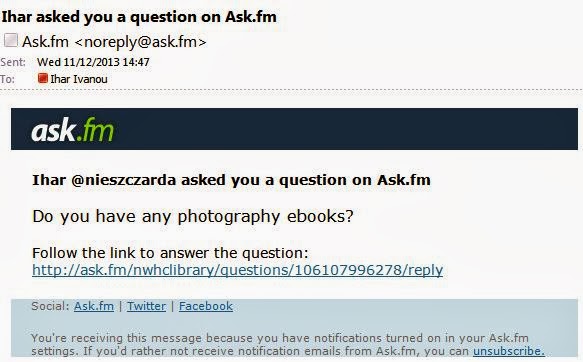
While I was reading the tragic news on bullying on ask.fm, it occurred to me that the site might be used as a virtual enquiry desk - for healthy communication with library users. It certainly has all the necessary basic functionality:
  • optional registration (questions can be posted very quickly, without a prolonged registration and login)
  • immediate notification of the posted question by email (currently the notification emails from ask.fm don't reach my college email boxes; I have raised the question with my IT colleagues)
  • RSS output (a widget can be created to display the questions and answers on the library webpage)
  • a widget - a bit too inflexible to my mind, but very easy to use - for embedding the query box anywhere on the internet.

I imagine, this may be handy for teaching too: learners can post their questions and comments; the tutor then will respond to them or ignore as appropriate.

05 August 2013

In students' eyes, there is nothing unusual about utilising Twitter for learning

Three years ago, I invited James Cunliffe, a photography tutor from the same college I work for, to write a guest post (http://nwhc-librarian.blogspot.co.uk/2010/03/facebook-in-fe-tutor-on-pros-and-cons.html) on his use of Facebook for teaching. That was the time of confusion: after consulting with tutors and managers, Facebook was blocked on on-campus PCs and tutors were told they could not communicate to learners on Facebook. Neither awareness campaign, nor training preceded the consultation, so the terrified voices - Facebook is evil! - were the loudest. Photography tutors’ experiment of using Facebook has survived and developed into the best example of utilising social media in our college I am aware of. Three years later, I learnt that something new and equally exciting has appeared – James and his colleagues have adopted Twitter for their practice. Here is what he told me recently:

James Cunliffe photoTwitter can be time consuming. Have you heard about the fear of missing out? There is always something out there, which you want to gather and share. In the beginning I was checking Twitter every day, posting, re-tweeting… I was doing it on the train during my 20-minutes journey. Recently, I’ve deliberately stepped back a bit and take it more casually now.

My colleagues, Andy and Hazel, are helping to look after the NWHC Photography Twitter feed (@nwhcphotography). For now, we don’t have any special arrangements who is going to reply or re-tweet. Perhaps, we will develop a strategy in that respect eventually.

19 July 2013

Collection development on a shoestring

Not sure whether this may become a series of posts, Collection Development On A Shoestring. For now, just a couple of ideas.

I have been thinking about the implications of the forthcoming funding cut on learning resources in my college; I expect 40-45% drop in comparison to the last year. Two immediate ideas regarding book collection development: (1) reducing the variety of titles we purchase and (2) moving more copies to short loan and reference-only status.

1.
Collection development will have to become more focused on the most essential and only best titles. The number of their copies may stay the same or even increase. Anything additional, optional will have to go. Eventually, this may lead to better utilisation of the collection.

Last year I noticed a huge increase in enquiries for books on Marx. We’ve immediately purchased a good selection of them. Almost all were snapped by a couple of students: each could borrow up to ten different titles. If we bought just two carefully selected books, six copies each, then six students could have them at the same time. This, of course, poses a question about how strong the library’s links with tutors are and how much of help tutors can be.

The only exception I can think of is Access to HE students: they often research unusual and polemical topics, and therefore they may suffer from a too prescriptive collection development practice. E-books may be the best solution for addressing their needs. It’s easier with HE students: they normally get detailed reading lists and universities expect college libraries to provide access to the titles on those lists. Most of FE-specific programmes rely heavily or even exclusively on one textbook. Providing those textbooks may be of more importance to learners than books purchased “just in case”.

2.
More reference-only copies will be disappointing to students who don’t have time or desire to study in the library. Librarians should promote copying and scanning services the CLA licence affords us with to address – at least partially – this problem.

15 July 2013

Libraries: from providing access to enabling and organising


Today, a college colleague of mine working on PhD asked me to help her access an article she identified on Google Scholar. My first thought was to check her university’s e-journal collection... That was a daunting task – the interface was pretty unusable; students’ reluctance to use peer-reviewed journals is not groundless, I thought.

To speed up the process, I repeated the search on Google Scholar, found six places the article was available from, one of those places was academia.edu – a social platform for research paper exchange. (The rest were paid-for platforms, we ignored them).

This made me to think that in the world were the published research becomes available free at the point of use more often, the role of libraries and librarians will be moving further towards enabling, research community organising, facilitation, advice and curation – away from offering access to the paid-for resources as their central function. Saying that, I am surprised that academia.edu was invented not by librarians – we’ve been in the business of institutional research publishing and archiving for years.

That, of course, relates to HE. For the FE sector, the picture is murky. I have just completed the last year SAR; most of the traditional KPIs (active borrowers, number of loans, even ebook usage etc.) are flat, growth happened in use of ILT/ICT equipment, PCs and learning space utilisation. If we logged IT- and study/research skills-related enquiries last year, those numbers would go through the roof too. And so, the murky picture starts getting shapes... One of my forthcoming posts will be on that.

27 June 2013

A small reflection on budget news

Today, I sent an email to my library team. It's full of questions; I am sure the answers will start coming soon too. Slightly edited, here it is:

Last night, I went to bed thinking about cuts: additional £11,5 billion the government shaves off the public sector (1/2 billion will come off education, i.e. you and me) and – I have been told – £xx,000 of our college library budget (after licences, travel and photocopying, this means the “book budget” will be half of what we’ve had this year).

Next year will not be disastrous for the service – we’ll be leveraging on the collection built in previous years. However, we’ll have to cut magazine subscriptions and purchasing (e)books straight away.

The service will eventually become irrelevant *if we continue focusing mainly on providing learning resources* – we’ll have not enough them to satisfy the demand anyway + I think, in the situation of very limited resources, mass unemployment (i.e. many students will not be able to afford even a textbook already costing almost half of the weekly jobseeker’s allowance) etc., teaching will be moving towards freely available resources, printouts, handouts on Moodle etc.

I am both sad with the cuts and hopeful that this will prompt us, the library team, to a radical reflection. We should spend some time thinking where the future for the library service in the college may be. Here is a blog post which has stayed with me for over a month now - http://philbradley.typepad.com/phil_bradleys_weblog/2013/05/envisioning-the-future.html Please look through it – long; read carefully the last three paragraphs. It’s talking about public libraries, but many thoughts are applicable to us as well.

The college’s mission is Transforming Lives and Unlocking Potential (I hope I remember it well) – how can the library, i.e. us, the team, be in the centre of that?

So, we need lots of creative thinking, engaged talking, supporting each other and going an extra mile where it makes sense (as well as surrendering anything that is just unnecessary balance).

11 April 2013

Google Removes Links to WordPress

Writing the previous post, I noticed that Blogger (i.e. Google) removes hyperlinks to WordPress content unless the the URLs are spelt out.

For example, a link blog should take you to the http://nwhclibrary.wordpress.com ... Well, it's greyed out and disabled. 

Looking At The Library Blog Statistics: users choose value-rich content

For almost three years, the college library has been using a blog (http://nwhclibrary.wordpress.com/) for marketing and user education. It’s been one of the most exciting and defining developments in the library’s recent practice.


I have learnt a lot since then, also by making mistakes. We have experimented with using the blog as a social platform for soliciting views and interaction with the users. We have tried to teach them how to follow blogs, and this blog in particular, using RSS feeds… to a very little effect. One of the important lessons I learnt was that the library users (and learners in general) will not flock to the specially designed for them virtual spaces. They may stumble upon the library where they are already spend their time, e.g. Facebook and Twitter, but any form of an active engagement on their part there is very unlikely – a college library simply can’t compete with our users’ own interests, hobbies and concerns. They may, however, look for the library when they need a quick fix of the forthcoming assignment or the OpenAthens access details – either for e-books or shopping discounts.

Top pages and posts for the first three months of 2013


08 March 2013

Annual Report for Marketing Library Service*

From several colleagues of mine in the FE sector I have heard that they produced annual library reports addressed to their line managers, but they rarely heard feedback or observed any change following those reports. The documents were likely to be lost in among other papers or forgotten in the emails inboxes.

Few years ago my college colleagues and I spend some time thinking on effective marketing for the college library. One of the bottlenecks identified was the lack of meaningful communication with the college managers and key stakeholders. The library has much to showcase and the college – to be proud of that, but the venues for speaking about our contribution to the college successes are extremely limited within the institution almost solely focused on measuring learners’ progression.

As any other college service or team, the library produces its annual self-assessment report which is then incorporated into the departmental/directorial SAR; at that stage it is probably archived. The college librarian’s line manager is the one who sees the document and, hopefully, makes some conclusions out of it; then its content is virtually lost for the college.